ASTRA Museum
ASTRA Museum

ASTRA Museum

Museum
08:00 - 18:00
Closed Opens at 08:00

Strada Pădurea Dumbrava 16-20, Sibiu, Romania

About

The mission of the ASTRA Museum is, for more than 100 years, to connect the audience with traditional values, through continuous change to the cultural needs of the society. Whether we are talking about Romanian, Saxon, other minority or even extra-European heritage, the ASTRA Museum is the keeper and the provider of the authentic values ​​to the community. Although its profile is ethnographic, the mission of the ASTRA Museum goes beyond the exclusive promotion of the traditional, becoming a true cultural promoter at the fusion between old and new, traditional and modern, national and global. To remain relevant to its audience, ASTRA Museum invests in programs meant to improve the cultural life of the community and encourage people to turn tradition into an active part of their daily lives. It has four museums with an extremely rich heritage varied regarding the geographical origin but also of the message it carries, the central goal of the ASTRA Museum is to represent a standard of good practices in Romanian and international museology.
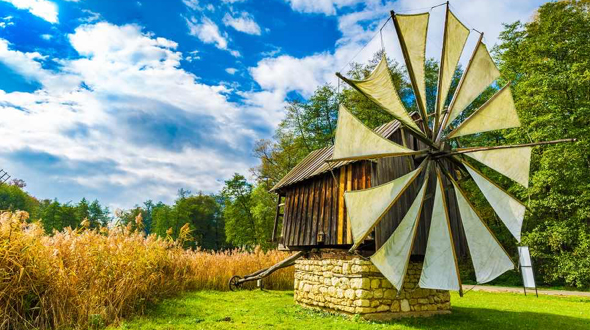
Successor and keeper of the heritage and values ​​of ”The Museum of the Association”, ”The Museum of Transylvanian Civilization ASTRA”, integral part of the ”C.N.M. ASTRA”, brings to its visitors, the charming world of the multiethnic Transylvania. A simple walk through the 96 hectares of ”The ASTRA Museum of Traditional Folk Civilization”, reveals to visitors an image of rural life throughout our country, exhibited in over 400 houses, household annexes and technical installations.

Emil Sigerus – The Museum of Saxon Ethnography”, curator of Saxon culture and civilization in Transylvania, successor of the Carpathian Museum, has the most important ethnographic collections with a Saxon profile, with the name of the great personality, with significant merits in this field, Emil Sigerus.

Franz Binder – The Museum of Universal Ethnography” is the only museum in Romania with the profile of capitalizing on extra-European heritage. Being in conservation for the moment, the museum defines its vision as an anthropological museum of world cultures, meant to understand the social phenomena of contemporary society.

The ASTRA Center for Heritage”, with its facilities, solves the issue of conservation and restoration on all types of support, based on solid theoretical and practical knowledge. Saving heritage requires dedication, understanding, knowledge and perseverance in the process of conservation and restoration the objects and monuments that are physical, chemical and biological degraded.

The Conservation and Restoration Training Center” – represents a substructure within the ASTRA Museum which has two essential missions among the museum functions. The first involves the preventive conservation of collections, and the second, the professional development of those who contribute to the preservation of cultural heritage.

ASTRA Museum” – publishing house, was established in 1995, continuing and developing the publication of monographs and periodicals initiated in 1966 by the specialized team led by Cornel Irimie, founder of the Open Air Museum in Dumbrava Sibiului.

Upcomming events

Photo Gallery

Similar Suggestions

Museum
Closed
Science Museum este un concept, un muzeu în continuă transformare. Este un spațiu de 170mp, unde copiii prin joaca vor descoperi fenomene din domeniul fizicii, chimiei, astronomiei si roboticii
Strada Turda 30, Sibiu 550052, Romania
Museum
Closed
Muzeu de artă new media în Sibiu. Pregătește-te pentru o experiență imersivă de neuitat. Program de vizitare Luni – Duminică: 10:00 – 22:00 Ultima oră de acces: 21:00 Închiderea instalațiilor și evacuarea spațiului se face la ora 22:00 BILETE AICI  • Copii sub 3 ani au acces gratuit. Peste vârsta de 3 ani toți vizitatorii achită biletul întreg. • Valabilitate bilete: Biletul este valabil 30 de zile de la data achiziției. • Biletul asigură un singur acces general pentru o persoană în toate încăperile vizitabile ale Immersive Museum Sibiu și la toate instalațiile și experiențele existente în program în ziua în care se realizează vizita. Durata vizitei este limitată doar de programul de închidere a muzeului în ziua intrării. Valabilitatea biletului încetează în momentul părăsirii spațiului IMS.
Strada Nicolae Bălcescu 13, Sibiu, Romania
Museum
Closed
Muzeul deține o colecție generoasă de păpuși îmbrăcate în porturi românești, săsești și țigănești, acestea fiind principala atracție. Încă de la intrare se pot observa câteva exponate așezate pe pervazul unui geam. Încăperea unde se află obiectele tradiționale este împărțită în două parți și anume, partea săsească și partea românească. „Am colecționat tot mai mult pentru că aveam senzația că dispare o lume, o lume veche, o lume a regulilor și a disciplinei” spune doamna Maria. Majoritatea obiectelor provin de pe Valea Hârtibaciului și din satul Săsăuș, satul de proveniență al colecționarei. Muzeul poate fi găsit pe Calea Gușteriței, nr. 54 B, iar intrarea este gratuită pentru oricine dorește să facă o mică incursiune în vremuri cu un farmec aparte și este curios să afle povești atât din viața comunității românești, cât și din cea săsească. Programul de vizitare este zilnic între orele 10-12 și 15-19, însă familia Drăgan este dispusă și dornică să primească vizitatori și în afara orarului.     sursa foto: Răzvan Negru sursa text
Calea Gușteriței 54, Sibiu, România
Museum
Closed
După o lungă perioadă de pregătire, am deschis pentru public Galeria Turismului Montan, o expoziție tematică care acoperă 150 de ani de turism montan în Carpați. Vă așteptăm la Cârțișoara, nr. 420 (pe Transfăgărășan), de Marți până Duminică între orele 10-18. Pentru vizitare ne puteți contacta la tel. 0722491435
Cartisoara, nr. 420, Cârțișoara 557075, Romania
Museum
5.0 1 review
Inaugurated in 1993, the "Franz Binder" Museum is the first and single museum of extra-European ethnography in Romania. The museum is organised in a historical monument building, built in the Neo-Gothic style between 1865 and 1867, initially as the headquarters for the Small Craftsmen Association and having various other functions over time. After its restoration in 1989 it became the headquarters of the "Franz Binder" Museum. The collections of the "Franz Binder" Museum (approx. 3000 exhibits) are divided into “old” ethnographic collections composed of exhibits donated during the second half of the 19th century and “new” collections which entered in the museum’s patrimony after 1990. The oldest collections are among the most valuable ones. They come from various parts of the world – the African continent being widely represented – and they were mainly collected on the field by members of the local and regional community and then donated to the Sibiu Association of Natural Sciences in Ardeal.
Visit in Sibiu County Sibiu Surroundings Museum
Closed
5.0 1 review
The Zosim Oancea Priest Glass Icons Museum
Strada Bisericii 329, Sibiel 557234, Romania
Museum
Closed
The permanent exhibition of Romanian Art was opened in the halls of the Blue House on November 25th, 2009. The exhibition circuit follows the painting evolution in Romania during the 18th – 20th century, based on chronologic and stylistic elements on display. The exhibition concept comparatively and synchronically emphasizes the representative artists of the national art and what it is specific to the Brukenthal collection: Transylvanian painting background (one of the richest of the country) completed with highly valued works of the modern and inter-war Romanian painting, until after the middle of the 20th century. Thus, the selection underlines the influences which the European art had over the national art, the interferences of the two artistic environments but also its specificity / originality. Without ignoring the creation of the Transylvanian painters Johann Martin Stock, Franz Neuhauser, Mişu Popp, Carl Dörschlag, Arthur Coulin or Octavian Smigelschi, who overreach with the charm and the unprecedented picturesque of their works, the new exhibition, based on the criterion of value, offers to the visiting public established works created by the following artists: Theodor Aman, Nicolae Grigorescu, Ion Andreescu, Ştefan Luchian, Hans Mattis-Teutsch, Corneliu Mihăilescu, Gheorghe Petraşcu, Theodor Pallady, Nicolae Tonitza, Alexandru Ciucurencu, Corneliu Baba, Ion Ţuculescu
Piaţa Mare, Nr. 5, Sibiu, România
Museum Landmark
Closed
5.0 1 review
The Brukenthal Museum is a special institution because it is the first museum established in Romania and Central Europe, in 1817. It owes its existence to one of the most important personalities in Transylvania: Baron Samuel von Brukenthal, the governor of the province in the second half of the eighteenth century.  The Brukenthal Palace and the Baron's collections are the core of today's Brukenthal National Museum, its gates opened to the public since its founding by the testament of its founder.  A visit to the museum is not limited to a single building and to a unique specialization: it becomes a journey presenting multiple aspects of the past and the present, in their metamorphosis. A metamorphosis mirrored into a wide array of objects displayed on 10,000 m2 of exhibitions, of which 5,500 represent new and recently refurbished spaces.  Initially displaying the European painting collection of Baron Samuel von Brukenthal in a single building, today the museum hosts a great diversity of valuable collections in nine buildings. Five of them are palaces built at different times: the earliest building (with foundation elements from the 13th century) is part of the architectural complex hosting the History Museum, while the latest is from 1901, hosting the Contemporary Art Gallery.
Piața Mare, Sibiu, Romania
1 event
Museum
Closed
The Steam Locomotives Museum was inaugurated in Sibiu on August 23rd, 1994. The collection activity of the most valuable steam locomotives of the Romanian railway network started since 1991. Today over 30 steam locomotives, ploughs and steam cranes that crossed the Romanian railway over one hundred years ago are made available to the public. The exhibits were built during 1885 and 1959 at Domeniilor Reşiţa Factory, 23 August Factory and Malaxa Factory of Romania, Schwartzkopff Factory, Orenstein & Koppel Factory, Borsig Factory of Berlin, Mavag Factory of Budapesta, Skoda Factory and others, including in Austria, Sweden and USA. Among them there are locomotives with wide track spacing and for narrow-gauge railway, the so-called funicular railway (narrow-gauge railway trains, which used to cross mountain areas). Two of these locomotives are functional and used on various occasions. On December 31st, 2000, the locomotives were declared, by order to the minister of culture, treasury patrimony, being protected by the law.
Strada Dorobanților, Nr. 22, Sibiu, România